Rwanda
Rwanda Fuel Surge Signals Economic Boom
Banks are poised to benefit from the surge through trade finance and working capital lending. Infrastructure projects linked to fuel distribution will also require significant financing

Rwanda’s fuel demand jumps 40%, boosting industrial activity, logistics, and banking opportunities across East Africa
Rwanda Fuel Demand Surge: A Catalyst for Regional Finance and Trade
A Sharp Rise in Fuel Use Signals Economic Acceleration
Rwanda has recorded a near 40% surge in fuel demand in early April 2026, a spike that is capturing attention across East Africa and beyond. This increase is more than a routine fluctuation; it reflects strengthening industrial activity, expanding logistics networks, and rising consumption across multiple sectors. Analysts view fuel consumption as a leading economic indicator, providing a real-time glimpse into the pace of growth, especially in energy-dependent sectors such as manufacturing, transport, and distribution.
The surge signals that Rwanda’s economy is moving from post-pandemic recovery to a phase of structural acceleration, aligning with regional ambitions to deepen trade, enhance industrial output, and integrate more fully into the continental economy.
Banking Sector: Seizing New Opportunities
Rwanda’s fuel surge presents a strategic opportunity for regional banks, particularly those headquartered in Nairobi and Dar es Salaam. Kenyan institutions like Equity Group Holdings, KCB Group, and Stanbic Bank Kenya are ideally positioned to intermediate the financing flows that will emerge from increased energy demand.
1. Trade Finance Expansion
Fuel imports and distribution are capital-intensive activities. Rising demand requires banks to provide letters of credit, insurance-backed trade facilities, and cross-border settlement solutions, ensuring that importers and distributors have timely access to capital. Regional banks with experience in East African trade corridors can leverage their infrastructure to capture a large share of this growing business.
2. Working Capital Lending
Logistics operators, fuel distributors, and industrial consumers will require short-term financing to cover operational costs. By extending working capital loans, banks can ensure that these businesses maintain smooth operations, while simultaneously building relationships with clients poised for long-term growth.
3. Infrastructure and Project Finance
The surge in fuel demand is likely to trigger investments in storage facilities, pipelines, and distribution networks. Structured project finance, often syndicated across multiple banks and supported by development finance institutions, will be crucial. Kenyan and regional lenders can play a pivotal role in channeling these funds, benefiting from fees, interest income, and strategic positioning in the market.

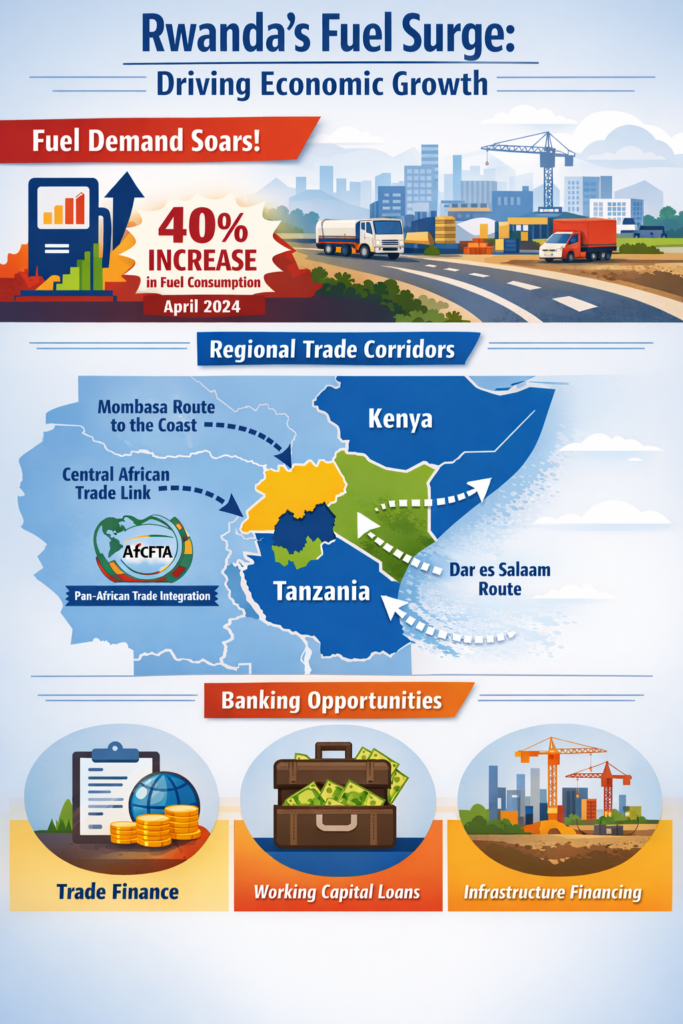
AfCFTA Integration: Fuel as a Continental Trade Driver
The timing of Rwanda’s energy demand boom coincides with the operationalization of the African Continental Free Trade Area (AfCFTA), creating a convergence of industrial growth, trade liberalization, and capital flow opportunities.
Energy-Driven Trade Corridors
Rising fuel consumption allows Rwanda to expand trade corridors, facilitating:
- Movement of refined petroleum products across borders
- Supply of industrial energy to manufacturing hubs in Uganda, Tanzania, and Burundi
- Integration of energy logistics with AfCFTA’s tariff-free framework
These developments increase intra-African trade volumes, reduce logistical bottlenecks, and provide financial intermediaries with a growing client base for trade finance solutions.
Catalyst for Private Sector Growth
AfCFTA encourages private sector participation, particularly in industrial development, transportation, and logistics infrastructure. With the fuel surge supporting increased production capacity, Rwandan businesses are better positioned to meet regional demand, amplifying opportunities for banks to finance expansion and capture cross-border revenue flows.
Investor Implications: Rwanda as a Frontier Opportunity
Global investors are closely monitoring Rwanda’s energy consumption trends. A 40% spike in fuel demand signals:
- Rising market potential for infrastructure and energy projects
- Increased need for capital allocation into trade finance and working capital solutions
- Potential for risk-adjusted returns through exposure to a fast-growing, frontier market
Development finance institutions and frontier energy funds are likely to participate in financing schemes, particularly when leveraged with regional banks acting as local partners.
Regional Banking Spillover: Nairobi as a Hub
Kenyan banks are well-positioned to benefit from Rwanda’s fuel demand surge due to:
- Established East African operations across trade corridors
- Strong foreign exchange and liquidity management platforms
- Experience in structured financing and project syndication
By intermediating cross-border flows, Nairobi-based institutions can capture fees, interest income, and strategic market positioning, effectively consolidating their role as the financial gateway for East African trade.
Risks and Considerations
Despite the positive outlook, several risks remain:
- Supply Chain Vulnerabilities: Disruptions in transport or import logistics could temporarily dampen demand or create cost pressures.
- Currency and Inflation Pressures: FX volatility may affect the cost of imported fuel and financing structures.
- Political and Regulatory Risk: Changes in tax policy, fuel pricing, or regional trade agreements could alter project economics.
Prudent risk management and structured financing will be key to safeguarding both banking returns and investor capital.
Strategic Takeaways
- Indicator of Economic Acceleration: Fuel demand is a real-time measure of Rwanda’s industrial and consumer activity.
- Banking Opportunities: Trade finance, working capital lending, and infrastructure projects will see increased demand.
- Regional Spillover: Cross-border trade corridors, especially via Kenya and Tanzania, will benefit from increased logistics activity.
- Investment Signal: Surge attracts global and regional capital, providing structured opportunities for financial institutions.
Bottom Line
Rwanda’s early April 2026 fuel demand surge is a macro-critical signal for East Africa’s industrial, financial, and trade ecosystem. For banks and investors, it presents strategic opportunities in trade finance, working capital, and project funding, while aligning perfectly with AfCFTA integration and regional economic growth.
As Rwanda accelerates, the ripple effects will extend across Nairobi, Dar es Salaam, and beyond, establishing a new paradigm in which fuel consumption, finance, and regional trade converge to drive East Africa’s next growth phase.