Governance & Ethics
Joe Sang: Inside Kenya’s Fuel System Breakdown
Thin Margins, High Risk
Fuel reserves below three weeks amplify every decision. Under such conditions, governance failures become economic crises.
An intelligence analysis of Joe Sang’s fall and how Kenya’s fuel system exposed structural failures across procurement and regulation.
Joe Sang and the Unraveling of Kenya’s Fuel Control System
A System Under Stress, Not a Man Alone
The arrest—and now resignation—of Joe Sang marks a decisive escalation in what is no longer a routine corruption probe but a systems-level rupture inside Kenya’s petroleum logistics architecture.
Alongside Sang, two other critical nodes in the energy chain fell: the Petroleum Principal Secretary and the head of Energy and Petroleum Regulatory Authority. Their coordinated removal signals something deeper than misconduct—it reveals a simultaneous breakdown across operator, regulator, and policy authority.
For international observers, this is the key:
The system did not fail at one point—it failed everywhere at once.
Who Is Joe Sang? The Operator at the Core
Sang is not a political figure in the traditional sense. He is a career technocrat who rose through finance and energy infrastructure roles to lead Kenya Pipeline Company (KPC), the entity that controls the movement and storage of petroleum across Kenya.
KPC:
- Handles over 90% of inland fuel transport
- Operates assets valued at roughly KSh120 billion (~$900 million)
- Connects Mombasa’s import terminals to inland consumption centers
This makes the KPC MD less a corporate executive and more a gatekeeper of national energy flow.
Sang’s career has not been without turbulence. His 2018 arrest over the Kisumu Oil Jetty project—where he was later acquitted—already positioned him within high-value, high-risk state infrastructure environments.
The Trigger: A Fuel Consignment That Broke the System
At the center of the current crisis lies a disputed fuel consignment:
- Flagged internally for quality concerns (notably sulphur levels)
- Held within KPC systems pending regulatory direction
- Subject to disagreement between agencies on whether to release it
At the same time, parallel imports—outside Kenya’s government-to-government (G-to-G) framework—were entering the market at dramatically different pricing levels:
- ~$84 per tonne (≈KSh10,900) via official channels
- ~$290 per tonne (≈KSh37,600) via alternative pathways
This divergence created a three-layer conflict:
- Technical: Is the fuel compliant?
- Economic: Who benefits from price differentials?
- Institutional: Who has final authority?
The system could not resolve these questions internally.

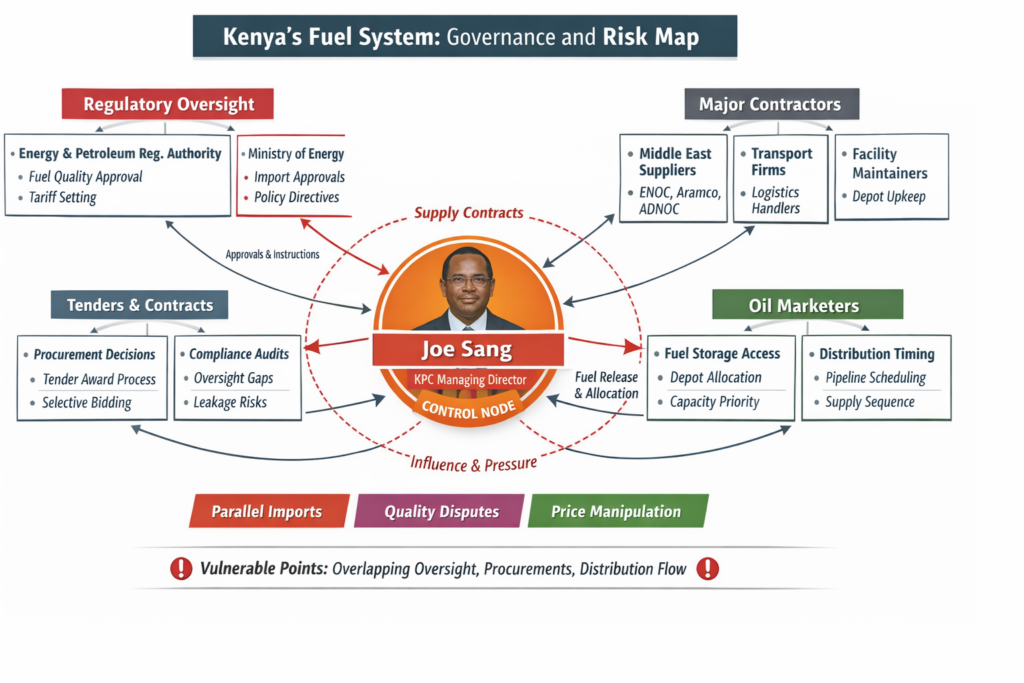
The Real Failure: No Final Decision Authority
What the Sang episode exposes is a structural flaw:
Kenya’s fuel system lacks a single, binding decision authority when disputes arise.
Instead, responsibilities are distributed:
- Energy and Petroleum Regulatory Authority certifies quality and pricing
- KPC controls storage and release
- The Ministry sets policy and approves imports
In theory, this separation ensures accountability.
In practice, it creates overlap, ambiguity, and paralysis.
When the disputed cargo emerged:
- KPC halted release
- Regulators hesitated
- Policy actors were drawn in
The result was escalation—not resolution.
Timing Matters: Supply Pressure as a Force Multiplier
This breakdown did not occur in a stable environment.
At the time of the arrests, Kenya’s fuel reserves were critically tight:
- Petrol: ~16 days
- Diesel: ~19 days
Such thin buffers transform operational disputes into national risk events.
Under these conditions:
- Delayed decisions disrupt supply
- Supply disruptions trigger price volatility
- Price volatility amplifies political and economic pressure
The system was not just flawed—it was stressed.
From Arrest to Resignation: Containment Mode
The subsequent resignation of Sang and his counterparts marks a transition from investigation to containment.
This move serves three purposes:
1. Stabilizing Operations
KPC continues functioning under interim leadership, ensuring fuel movement does not halt.
2. Reasserting Political Control
By removing all three nodes—operator, regulator, and policy—the state resets command over a destabilized system.
3. Managing Optics
The narrative shifts from systemic failure to individual accountability, even if the underlying issues remain unresolved.
Network Map Reality: Parallel Systems Inside One System
The intelligence map of Kenya’s fuel chain now reveals dual pathways operating simultaneously:
Official Pathway
- Government-to-government procurement
- Regulated pricing
- Formal approvals
Parallel Pathway
- Independent importers
- Higher-priced cargoes
- Less transparent entry points
These systems intersect at KPC—where fuel is stored, moved, and released.
This is where control becomes power—and where ambiguity becomes risk.
Joe Sang Reframed: Actor or Node?
With his resignation, Sang’s role becomes clearer in analytical terms.
He is not best understood as:
- A lone decision-maker
- Or a proven corrupt actor
Instead, he is:
A recurring operator positioned at critical friction points within a structurally vulnerable system.
His repeated exposure—to the 2018 jetty case and now the 2026 fuel probe—reflects where he sits, not necessarily what he has done.
Strategic Implications
For investors, policymakers, and international observers, three conclusions stand out:
1. Infrastructure Control Equals Economic Influence
Midstream logistics—pipelines, storage, scheduling—carry hidden but significant pricing power.
2. Governance Design Determines Risk
Overlapping mandates without clear escalation protocols create:
- Decision paralysis
- Accountability gaps
- Legal exposure
3. Crisis Response Does Not Equal Reform
Removing individuals stabilizes perception but does not:
- Eliminate parallel procurement channels
- Clarify authority boundaries
- Strengthen audit mechanisms
Bottom Line: A System Exposed
Joe Sang’s rise, arrest, and resignation form a narrative arc—but they are not the story’s core.
The real story is this:
Kenya’s fuel system—designed with distributed authority—has revealed its inability to resolve high-stakes conflicts under pressure.
Until that structural weakness is addressed, the risk remains:
- Not of another Joe Sang
- But of another system failure