
Fintech
Top Capitalized Fintechs in East Africa 2025
The region’s leading fintechs are attracting significant capital to support innovation and market penetration. Their platforms are expanding access to financial services for millions.


Discover East Africa’s top capitalized fintechs in 2025 driving payments, lending, and digital finance innovation.
Top 10 Capitalized Fintech Companies within the East Africa region (2025) — including founders, estimated valuation/capitalization, industry focus, country base and regional footprint. Because most fintechs in Africa are privately held, estimates come from credible published valuation and industry reports where available.
📊 Top 10 Capitalized Fintech Companies in/with East Africa — 2025
| Rank | Fintech | Founder(s) | Est. Valuation / Capitalization (USD) | Country Base | Footprint | Industry |
|---|---|---|---|---|---|---|
| 1 | M-Pesa | Nick Hughes & Susie Lonie | ~$5.1 B | Kenya (Safaricom/Vodafone) | Kenya, Tanzania, Ghana, South Africa, India & more | Mobile money, payments, savings, loans |
| 2 | Flutterwave | Olugbenga Agboola & Iyinoluwa Aboyeji | ~$3 B | Nigeria (Large Kenya operations) | 30+ African countries incl. Kenya & Uganda | Payments infrastructure & cross-border payments |
| 3 | Tala | Shivani Siroya | ~$1.75 B | Kenya | Kenya, Tanzania, India, Philippines | Digital micro-lending & credit scoring |
| 4 | Chipper Cash | Ham Serunjogi & Maijid Moujaled | ~$2 B (prior) | Kenya | Kenya, Uganda, South Africa, Ghana | Cross-border P2P payments & wallets |
| 5 | JUMO | Andrew Watkins-Ball | ~$400 M | South Africa (Kenya focus) | Kenya, Uganda, Tanzania, Ghana & others | Banking-as-a-service, savings & credit |
| 6 | M-KOPA | Jesse Moore et al. | ~$500–600 M | Kenya | Kenya, Uganda, Tanzania, Nigeria & more | Pay-as-you-go credit & digital finance |
| 7 | Cellulant | Ken Njoroge & Bolaji Akinboro | ~$47 M+ | Kenya | Kenya, Uganda, Tanzania, Rwanda, Nigeria | Payments gateway & digital wallets |
| 8 | 4G-Capital | Wayne Hennessy-Barrett & Genevieve Hennessy-Barrett | Not publicly valued | Kenya | Kenya, Uganda | SME digital loans & financial tools |
| 9 | Pesapal | Senior leadership (e.g., Zubair Moti) | Not publicly disclosed | Kenya | KE, UG, TZ, RW | Payment gateway & merchant services |
| 10 | Kopo Kopo | Jesse Moore | ~$5 M+ | Kenya | KE, UG, TZ, RW | Merchant mobile payments & SME support |
📌 Quick Industry & Capitalization Notes
1. Mobile Money Still Leads — M-Pesa
- Valuation: ~US$5.1 billion, making it one of Africa’s highest-value fintech brands.
- Impact: Tens of millions of users; extensive agent network; includes savings and lending features linked to mobile money wallets.
2. Pan-African Payments Powerhouses
- Flutterwave (~$3 b) and Chipper Cash (~$2 b at peak) anchored by broad merchant services and cross-border transfers. (Valuations from latest credible funding rounds.)
- Tala stands out in digital credit with a near-unicorn valuation (~$1.75 b).
3. Growth & Regional Players
- M-KOPA’s asset-backed pay-as-you-go fintech model serves millions and pulls strong capital inflows.
- JUMO remains a key BaaS and microfinance enabler in multiple countries.
- Cellulant, Pesapal, 4G-Capital and Kopo Kopo are locally developed East African players with foundational roles in payments and SME finance, though generally smaller or without public valuation data.
📊 Footprint & Industry Insights
📍 Geographic Spread:
- Core East African hubs are Kenya, Uganda, and Tanzania, though many fintechs also serve West Africa, South Africa and beyond via pan-African expansion strategies.
📍 Industry Focus Areas:
- Mobile money & wallets: M-Pesa, Pesapal
- Cross-border payments & merchant services: Flutterwave, Chipper Cash
- Digital lending & microcredit: Tala, JUMO
- SME fintech & business finance: 4G-Capital, Kopo Kopo, Cellulant
- Pay-as-you-go services: M-KOPA
📌 What “Capitalization” Means Here
- Fintechs in East Africa are mostly privately held, so their “capitalization” value refers to latest known funding valuations (Series funding rounds or credible market estimates) — not publicly traded market caps.
- M-Pesa’s valuation estimate comes from aggregated industry reports, which place it among Africa’s top fintech valuations.
📈 Strategic Takeaways
- Mobile money remains Africa’s fintech backbone, with M-Pesa leading by a wide margin in valuation and user base.
- Cross-border and merchant payment solutions like Flutterwave and Chipper Cash have become integral to regional trade and commerce.
- Digital credit and financial inclusion platforms continue capturing new markets where traditional banking services are limited.
⚠️ Note: “Capitalization” here refers to latest known valuations, funding round valuations, or credible estimate values. These numbers are the best available public estimates for 2025 fintechs with significant activity in East Africa.
Fintech
MTN vs Airtel: Uganda Telecom Showdown
Airtel is gaining momentum through data growth and pricing strategy. MTN relies on scale, liquidity, and infrastructure dominance to defend its lead.
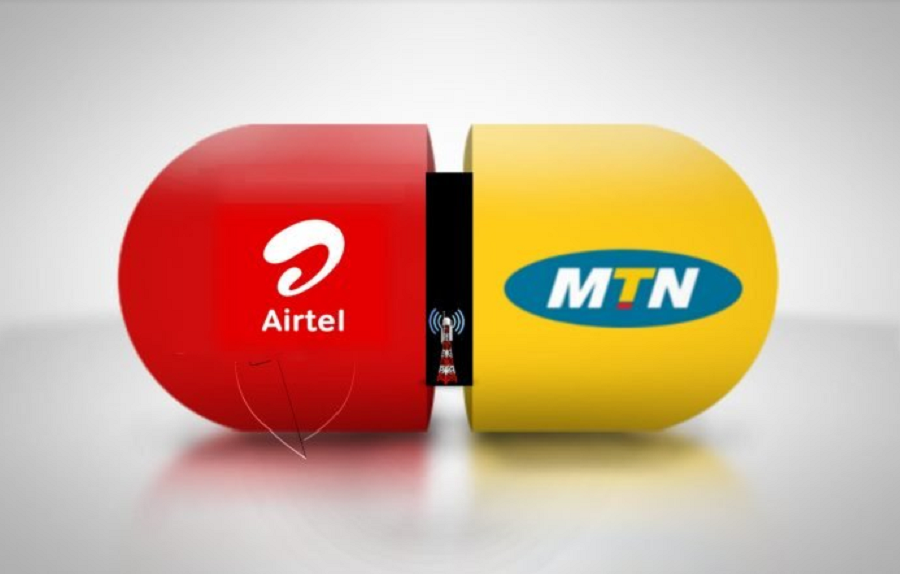
MTN and Airtel compete in Uganda’s telecom market, balancing strong finances with fast earnings growth in digital services.
MTN vs Airtel: Balance Sheet Strength Meets Earnings Momentum
Uganda’s telecom market is entering a decisive phase. MTN Uganda and Airtel Uganda are competing aggressively for dominance.
The sector is being reshaped by rising demand for mobile data, digital payments, and fintech services. Each operator is pursuing a different strategy. MTN is leveraging its strong balance sheet. Airtel is pushing rapid earnings growth.
The key question is simple. Which company can convert network investment into sustainable long-term returns?
MTN’s Balance Sheet Advantage
MTN Uganda holds a clear advantage in financial strength. The company reported cash reserves of over $200 million (about USh750 billion) in its latest filings. This provides flexibility for capital expenditure and expansion.
Strong liquidity allows MTN to invest consistently. It is expanding 4G coverage and testing 5G capabilities. These upgrades improve service quality and customer retention.
MTN is also investing in digital platforms. Its mobile money ecosystem (MoMo) remains a core revenue driver. According to MTN Group investor updates, fintech now contributes a growing share of earnings.
This financial strength gives MTN resilience. It can absorb short-term shocks. It can also outspend competitors when necessary.
Airtel’s Earnings Momentum
In contrast, Airtel Uganda is delivering faster earnings growth. The operator has focused on customer acquisition and pricing strategy. This approach is boosting revenue and market share.
Airtel’s data revenue has grown rapidly. Usage has increased as smartphone penetration rises. The company is targeting urban and high-value customers. These segments generate higher average revenue per user (ARPU).
Its Airtel Money platform is also expanding quickly. Mobile financial services are becoming a major growth driver. Analysts estimate that mobile money transactions in Uganda exceeded $10 billion (USh37 trillion) in 2025.
Airtel is positioning itself as a growth story. It is prioritising revenue acceleration over balance sheet expansion.
Mobile Money: The Real Battleground
The real competition is no longer voice or SMS. It is mobile money and digital services.
Both operators dominate Uganda’s fintech space. MTN leads in market share. Airtel is closing the gap. The competition is intense.
Mobile money generates transaction fees, lending revenue, and ecosystem stickiness. Customers who use mobile wallets are less likely to switch providers.
According to the Bank of Uganda, digital payments continue to rise sharply. This trend is expected to accelerate.
The operator that scales its ecosystem faster will gain a decisive advantage. This includes payments, savings, loans, and merchant services.
Network Strategy: Rural vs Urban Focus
Network investment strategies differ significantly.
MTN is expanding into rural and underserved regions. This builds long-term market share. It also supports financial inclusion. However, returns can take time.
Airtel is focusing on urban densification. It targets high-usage customers in cities. This strategy boosts short-term earnings.
Both approaches have trade-offs. MTN’s model supports scale and stability. Airtel’s model drives faster profitability.
The challenge for both is balancing capital expenditure (CAPEX) with revenue growth.
Competitive Pressure and Pricing
Competition is intensifying. Pricing remains a key battleground.
Promotions, data bundles, and mobile money incentives are being used aggressively. This benefits consumers but compresses margins.
Analysts warn of potential price wars. Operators with stronger balance sheets are better positioned to withstand prolonged competition.
This again highlights MTN’s advantage. However, Airtel’s lean growth model could still deliver superior returns if executed efficiently.
Market Outlook
Uganda’s telecom sector is projected to grow at 8–10% annually over the next three years. Growth will be driven by:
- Rising smartphone adoption
- Expanding digital financial services
- Increased data consumption
The market remains underpenetrated. This creates long-term opportunities.
Some analysts also expect strategic partnerships or ecosystem expansion. Telecom firms are evolving into technology and financial service providers.
Conclusion: Strength vs Speed
The MTN-Airtel rivalry reflects a broader industry shift.
MTN represents financial strength and long-term investment. Airtel represents speed, efficiency, and earnings growth.
The winner will not simply be the biggest operator. It will be the one that successfully aligns:
- Network investment
- Digital ecosystem growth
- Customer monetisation
Uganda’s telecom market is no longer just about connectivity. It is about owning the digital economy.
And in that race, both MTN and Airtel remain formidable contenders.


Stanbic Women Finance Surge in Kenya

Stanbic Bank East Africa’s AI Risk Transformation

Joe Sang: Inside Kenya’s Fuel System Breakdown


-

 Economy & Policy7 days ago
Rwanda Tops 2026 Investment Attractiveness Index
-

 Commercial Banking6 days ago
Kenya Banks Competitive Growth Insights 2026
-

 Commercial Banking3 days ago
Standard Bank Growth Plan Faces Africa Risks
-

 Top Banks6 days ago
Top 10 Capitalized Banks in East Africa 2025
-

 Boardroom Leadership5 days ago
East Africa Women CEOs 2025 Rankings
-

 Entrepreneur5 days ago
East Africa’s Richest 2025: Top 10 Revealed
-

 Insurance6 days ago
Top 10 Capitalized Insurers in East Africa 2025
-
 Commercial Banking7 days ago
Standard Bank Ethiopia: Measured Entry Strategy